Backup Strategy for SMEs: The 3-2-1 Rule Explained
Data loss can cripple your business in hours. Ransomware, hardware failure, or a simple human mistake can wipe out years of work. Yet 21% of people have never backed up their data. A solid backup strategy is your insurance policy against disaster.
Why Backups Are Critical
Your data is your business. Without proper backups, you are one ransomware attack, one hardware failure, or one accidental deletion away from disaster. Ransomware attacks are the top reason businesses lose data, and proper backups are your best defense. Having an incident response plan that includes backup restoration is equally important.
Ransomware
Encrypts your files and demands payment. Without backups, you either pay or lose everything.
Hardware Failure
Hard drives fail. SSDs fail. RAID is not a backup. When hardware dies, data dies with it.
Human Error
Accidental deletion, overwriting files, or misconfiguration. The most common cause of data loss.
Natural Disasters
Fire, flood, theft. If all your backups are in the same building, one event can destroy everything.
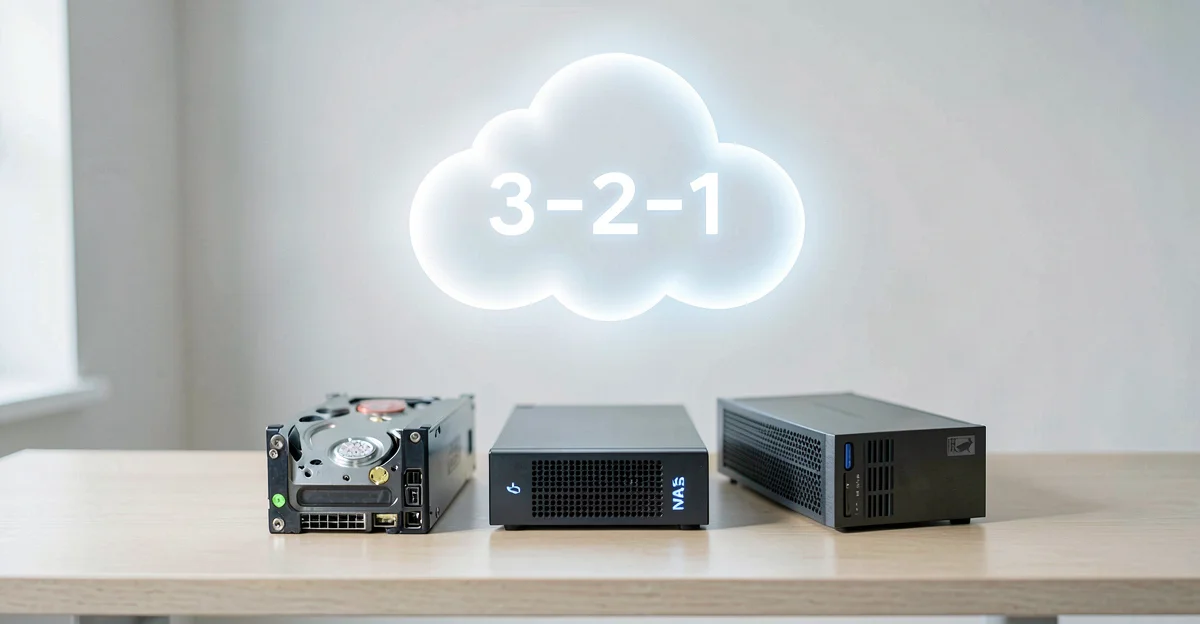
The 3-2-1 Backup Rule
The gold standard for backup strategy. Simple to remember, effective to implement.
3 Copies
Keep at least 3 copies of your data: 1 primary and 2 backups. If one fails, you have two more.
2 Media Types
Store backups on 2 different media types (e.g., local NAS and cloud). Protects against media-specific failures.
1 Offsite
Keep at least 1 copy offsite or in the cloud. Protects against local disasters (fire, flood, theft).
Types of Backups
Not all backups are the same. Choose the right type based on your needs.
Full Backup
Complete copy of all data. Slow but reliable. Best for weekly or monthly backups.
Incremental Backup
Only backs up changes since last backup. Fast and efficient. Best for daily backups.
Differential Backup
Backs up changes since last full backup. Middle ground between full and incremental.
Cloud vs Local Backup
Each approach has strengths. The best strategy combines both.
| Type | Speed | Storage | Cost | Best For |
|---|---|---|---|---|
| Local (NAS) | Fast | Limited | Medium | Quick recovery |
| Cloud | Slow | Unlimited | Monthly | Offsite safety |
| Hybrid | Medium | Flexible | Higher | Complete protection |
What Should You Backup?
Not all data is equally important. Prioritize what matters most.
Critical Business Data
- Customer databases
- Financial records
- Contracts and legal documents
- Email archives
Configurations
- Server configurations
- Network settings
- Application configs
- License keys
Systems
- Operating system images
- Virtual machines
- Database dumps
- Application installations
How Often Should You Backup?
Your Recovery Point Objective (RPO) determines how much data you can afford to lose.
| RPO | Use Case | Backup Type |
|---|---|---|
| Real-time | Financial transactions, e-commerce | Continuous replication |
| 1 hour | Active customer data | Hourly incremental |
| 24 hours | Documents, email | Daily incremental |
| 1 week | Archives, static files | Weekly full backup |
Testing Your Backups
A backup you have never tested is a backup that might not work. This is the most forgotten step!
Verify integrity
Check that backup files are complete and not corrupted.
Test restoration
Actually restore files to a test environment. Do not assume it works.
Measure time
Know how long a full restore takes. Plan for downtime.
Document process
Write down the steps. In a crisis, you need clear instructions.
Schedule regular tests
Test quarterly at minimum. Make it part of your routine.
Patch Your Backup Software First
Ransomware crews go after backup servers first: destroy the backups, and the victim has little choice but to pay. That makes your backup software the single highest-value patch target in your network.
Veeam CVE-2026-44963 (June 2026)
On June 9, 2026 Veeam disclosed a critical flaw (rated 9.4 out of 10) in Backup & Replication: any signed-in domain user could run code on a domain-joined Veeam backup server. The Centre for Cybersecurity Belgium (CCB) issued a warning on June 10, 2026. The fix shipped in build 12.3.2.4854; version 13 and servers running in workgroup mode were not affected.
- Treat backup software updates as critical: apply them within 48 hours, ahead of the regular monthly cycle.
- Where the vendor supports it, run the backup server in workgroup mode instead of joining it to the domain, so one stolen user account cannot reach it.
- Keep at least one backup copy offline or immutable, so even a compromised backup server cannot erase everything.
NIS2 and Backup Requirements
Under NIS2, backup is not optional. It is part of mandatory business continuity requirements.
Business Continuity Plans
Organizations must have documented backup and disaster recovery procedures.
Incident Recovery
Ability to restore systems and data after a security incident.
Regular Testing
Backup procedures must be tested regularly to ensure effectiveness.
Documentation
Keep evidence of your backup strategy and test results for compliance.
Ready to improve your backup strategy?
Easy Cyber Protection helps you implement the right backup procedures as part of your cybersecurity compliance.
Frequently Asked Questions
What is the 3-2-1 backup rule?
The 3-2-1 rule means keeping 3 copies of your data, on 2 different media types, with 1 copy stored offsite. This protects against hardware failure, media corruption, and local disasters like fire or flood.
How often should I backup?
It depends on your RPO (Recovery Point Objective). Ask yourself: how much data can I afford to lose? For most SMEs, daily incremental backups with weekly full backups is a good starting point.
Is cloud backup safe?
Yes, when done correctly. Choose reputable providers (AWS, Azure, Google Cloud, or specialized backup services). Ensure data is encrypted in transit and at rest. For EU compliance, verify data stays within the EU.
What should I backup?
Priority order: 1) Critical business data (customer info, financial records), 2) Configurations and settings, 3) System images. Document what you back up and verify nothing critical is missed.
How do I test my backups?
Schedule quarterly test restorations. Restore files to a test environment and verify they work. Measure how long a full restore takes. Document the process so anyone can follow it in an emergency.
Related Articles
Sources
- CISA: Protect Your Data with a Backup Strategy — Cybersecurity and Infrastructure Security Agency
- The 3-2-1 Backup Rule — Veeam
- Centre for Cybersecurity Belgium (CCB) — CyberFundamentals Framework
- NIS2 Directive — European Commission